

Written by Sherri Snelling*
June is Alzheimer’s and Brain Health Awareness Month which makes a recent Wall Street Journal article referencing the importance of brain health and cognitive wellness throughout the lifespan very timely. The article focused on the Super Agers (those thriving into their 80s and beyond) and how a Pew Research Center survey found most of these octogenarians are hoping to live into their 90s with almost a third wanting to become centenarians.
Senior living communities are bracing themselves for this onslaught of longevity lovers, innovating how the current footprint of 2-3 million current residential beds can accommodate a growing aging population needing care. Home care agencies are scrambling to supply the staff of professional caregivers to care for the 12-24 million solo agers and others who want to age in place. And, memory care communities will become even more essential as today’s more than 7 million Americans living with Alzheimer’s or related dementia (ADRD) – will continue to increase to 13 million by 2050.
But whether it is a Super Ager looking for the luxury resort-style living trend of the latest life plan and assisted living communities, or a person living with dementia (PLWD) who needs memory care, both senior living operators and home care agencies know the next 20 years will be transformative and disruptive. The longevity question is can we help lifespans equal healthspans and even more importantly, brainspans.
It is one of the reasons why AgeTech and NeuroTech innovations are becoming critical differentiators for long-term care community and home services. Aging in place is transforming from a housing choice into a wellness hub where health, technology and human support delivered in the home makes longevity possible.
As well, many senior living operators are looking to expand their business models by developing relationships with future residents while they are still at home. While most older adults enter assisted living or memory care in their late 70s or early 80s – they may live beyond today’s average 3-5 years in those communities. And, senior living would like to make this life transition seamless and earlier by engaging with prospective residents while in their 50s and 60s as the trend in senior living home services and home care partnerships are demonstrating.
The frontier of this trend is predictive rather than reactive. AI-driven systems can identify early indications of decline; gait changes, sleep quality and routines all allowing for earlier, less invasive interventions. And to achieve optimal brainspans, long-term care providers are realizing they have to embrace both NeuroTech and NeuroDesign.
What is NeuroDesign?
The Neuro Era is here – whether it is neurowellness, neurodesign, neuroaesthetics, neuroscience or the latest neurotechnology – it is where brain health, mental health and cognitive health are changing everything related to aging, human performance and quality of life (QoL). NeuroDesign is seen in everything from restaurants and hospitality environments to wellness products, arts and entertainment programs, mental health initiatives, fitness programs and our living spaces. It is about the balance between the overwhelmingly stressful aspects in our lives with the soothing nature elements our brains crave and help achieve nervous system regulation.
NeuroDesign is an aspect of Neuro Wellness that focuses on environmental ecosystems as a key player in healing, health and wellness. And NeuroTech are products designed to optimize brain health and performance to support those goals.
Our built environments are now recognized as determinants of healthspans and brainspans. Housing and community designs are taking a new look at walkability, lighting, acoustics, access to nature, color psychology and social spaces that directly influence mobility, cognition, mental well-being and psychosocial connections that support longevity independence.
Wellness real estate developers are integrating evidence-based design—like circadian lighting, biophilic design, intuitive wayfinding and flexible communal spaces—to support daily function and reduce stress. This trend extends beyond individual homes and buildings to neighborhoods and urban and city planning.
By embracing NeuroDesign, innovators are integrating how the human brain subconsciously processes visual, auditory, and tactile elements and are creating products and environments that reduce stress, boost focus and memory, improve sociability and sleep, encourage mobility and enhance overall emotional well-being.
NeuroDesign is no longer a specialty feature of higher-end senior living communities promoting wellness or wealthy households that have embraced biohacking and biometric measurement. It is now table stakes for all living environments to create spaces that are healing and optimize independence and quality of life.
NeuroTech and Neural Networks
While NeuroDesign is beneficial for all older adults, NeuroTech takes brainspan to a personal level with individualized data and feedback via artificial intelligence (AI) to guide evolving wellness routines and activities.
Many tech innovators are embracing the NeuroTech movement – this includes the plethora or sleep science gadgets and apps, meditation and breathing apps, brain exercise systems and more. Startups that promote multisensory engagement such as singing and musical programs, circadian lighting systems, scent training systems and more are being used in memory care and dementia care at home.
Other companies like Theora Care, have taken the behavioral approach to NeuroTech by encouraging older adults, including PLWD, to remain mobile and curious, to explore their environments without fear of falls or wandering – which we know 60% of the dementia population will encounter. By living with no fear, staying active and socially engaged, many older adults will achieve the brainspans they want. The personalized data of using advanced GPS technology to track location but also AI to analyze data are the tools that allow for more independence and freedom longer for older adults.
What is unique about Theora Care’s technology in a crowded wearable space is the neural networking technology – the next level of AI. It is AI 2.0 machine learning, also known as deep learning, where the patterns of interconnected nodes or neurons are communicated in a layered structure that resembles the human brain. Essentially neural networks mirror what we see happening in the brain where neurotransmitters are carrying messages and new neuronal information is synthesized into complex learning but also building new neural scaffolds called “neuroplasticity” to create even more detailed connections. You could call neural networks a “virtual brain” where it does just what the human brain does only using technology instead of biology.
The data gathered allows for better predictability in physical issues such as balance that goes beyond the “detection only” aspect of many other falls prevention apps and services.
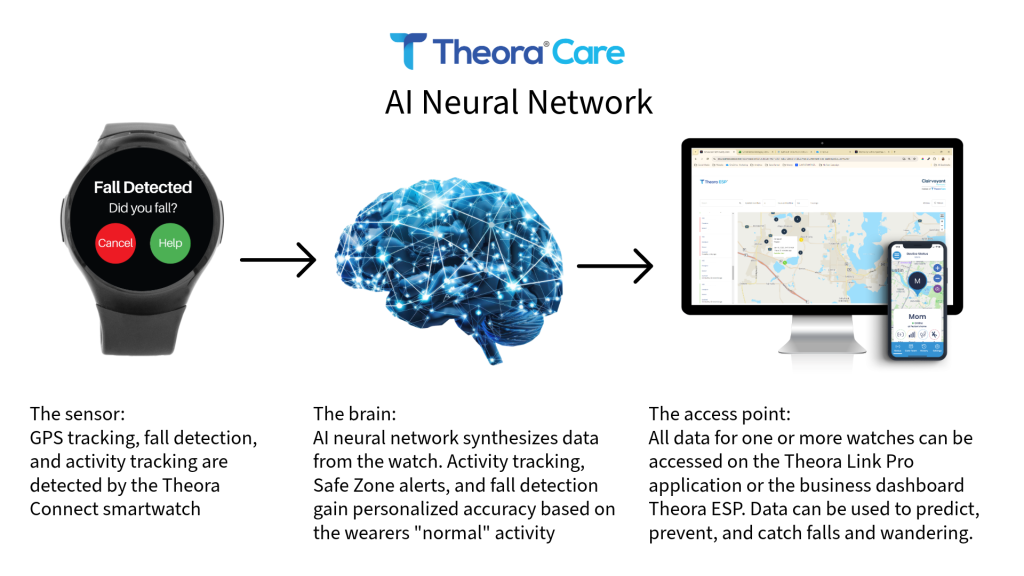
When senior living operators and home care agencies use Theora Care, the results are that long-term care staff can now have personalized real-time and trends-over-time data on residents to help prevent harmful falls or wandering situations and families and home care workers can have better peace of mind that a loved one can pursue the activities they loved with more independence. This is the quality of life everyone should enjoy that supports healthspans and brainspans.
*Sherri Snelling is a corporate gerontologist, author, and Founder/CEO of the Caregiving Club. Her expertise is in family caregiving, Alzheimer’s/brain health, and neuro design for the home.
Written 1 June 2026